
DPMO Calculator Tutorial
Tutorial
Sigma Level Calculator Tutorial
Note: This tool was formerly known as “Sigma Level Calculator” and is referred as such in this video. We will update this tutorial in the near future.
When to use this tool
One of the critical lessons of Six Sigma is that important activities should be measured. When you play a sport, the performance of each team is measured by the score. The score is a measurement, or metric, that communicates how well each team is performing.
The metric indicates whether or not the objective was achieved. Business process metrics can tell a similar story about company performance. Six Sigma uses a metric of Defects per Million Opportunities (or DPMO). A low number of Defects, or low DPMO, leads to high customer satisfaction, if customers are satisfied, then total sales, market share, and profitability will also be favorable.
This template is used to calculate the DPMO of your process for either discrete data (top section) or continuous data (lower section).
How to use this tool in EngineRoom
- Select DPMO Calculator from the Measure (DMAIC) menu > Process Capability.
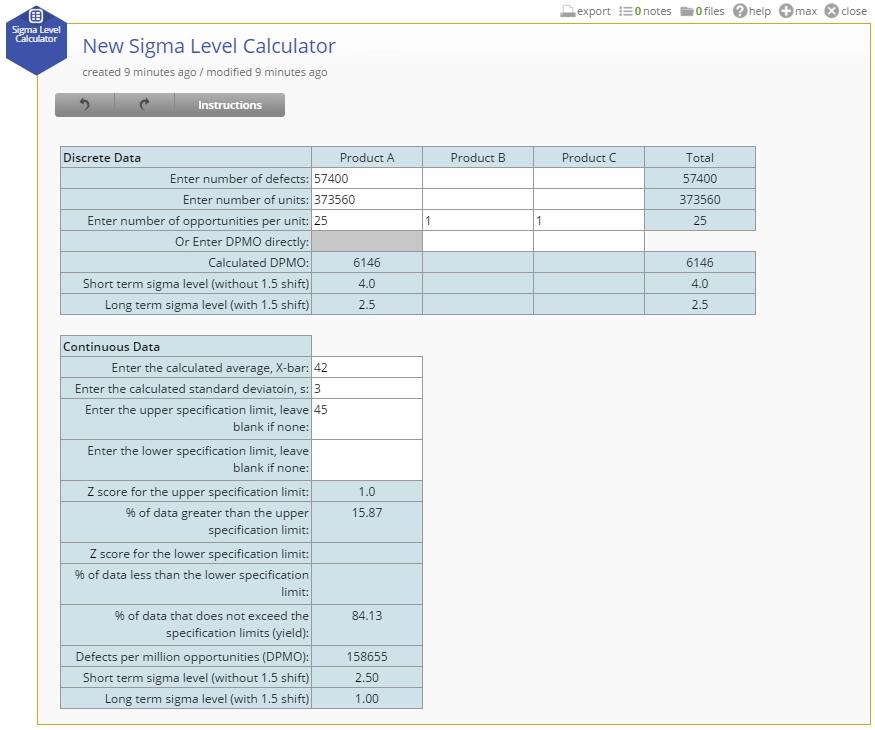
- For discrete data, up to 3 products may be entered in the columns titled Product A, B, and C. DPMO will be calculated from the Defects, Units, and Opportunities cells for each product.
- If you are looking for a metric like Sigma Level, you can enter DPMO directly. When you click on any of the three white cells you will see that the DPMO cell turns grey. If you click on the DPMO cell, the top three cells will turn grey. Only the selected cell (in white) will be used for the sigma level calculation for that product. If you have not directly entered any DPMO numbers (no grey cells in the top three) then the Total sigma level will be calculated based on the weight average number of defect opportunities.
- For continuous data, simply enter your process mean, standard deviation, and the upper and lower specification limits. You can also just enter a single limit for a single-sided specification.
Notes:
As information is entered, options that are no longer relevant become unavailable (are greyed-out) and the results are calculated as soon as the minimum required information for a given formula is present.
A DPMO Calculator example is shown below:
Was this helpful?